The Complete Cost of Solar in the Cayman Islands
System pricing by size, the CORE credits you can earn, payback period math, financing options, and the 25-year picture — the real economics of going solar in Cayman in 2025.
Introduction
The brilliant Caribbean sunshine that makes the Cayman Islands such a paradise for residents and visitors alike also represents an extraordinary opportunity for homeowners and businesses. With electricity costs among the highest in the region and a government committed to ambitious renewable energy goals, solar power has never been more attractive as an investment. Yet for many Caymanians, uncertainty about the true costs, potential savings, and return on investment remains a significant barrier to making the switch.
In this comprehensive guide, we'll break down the real economics of solar power in the Cayman Islands in 2025, giving you the transparent information you need to make an informed decision about powering your home or business with the sun.
Solar in Cayman has never been more attractive — yet uncertainty about the real numbers remains the single biggest barrier.
Initial Investment: What Does Solar Really Cost in Cayman?
The upfront cost of a solar system in the Cayman Islands depends on several factors, including system size, equipment quality, installation complexity, and whether you include battery storage.
System Size and Base Costs
For residential properties in the Cayman Islands, solar systems typically range from 5 kW to 15 kW, depending on your energy needs and available installation space. As of 2025, here's what you can expect to pay:
| System size | Indicative price (CI$) | Best fit |
|---|---|---|
| 5 kW (small) | $15,000 – $20,000 | Smaller homes, modest CUC bills |
| 10 kW (medium) | $25,000 – $35,000 | Most family homes |
| 15 kW (large) | $35,000 – $50,000 | High-usage homes, light commercial |
These base prices include panels, inverters, mounting hardware, and standard installation. The wide range reflects differences in equipment quality — premium high-efficiency panels command higher prices but deliver better performance and longevity.
Additional Components
Beyond the basic solar panel system, you may want to consider:
- Battery storage — approximately CI$1,000 – CI$1,500 per kWh of storage. A typical home might require 10 – 15 kWh, adding CI$10,000 – CI$22,500 to the system cost.
- Solar water heating — roughly CI$4,000 – CI$7,000, reducing one of your home's largest energy consumers.
- Smart monitoring systems — CI$500 – CI$2,000 depending on capabilities.
- Roof modifications — if your roof requires structural reinforcement, expect CI$1,000 – CI$5,000.
Installation Considerations
The complexity of your installation can significantly impact costs:
- Roof type and condition — metal roofs typically offer the most straightforward installation; tile or shingle roofs may require additional work.
- Roof orientation and shading — ideal south-facing roof sections with minimal shading achieve maximum efficiency. Less optimal conditions may require additional panels or special mounting.
- Electrical upgrades — older homes may need panel upgrades to accommodate solar, potentially adding CI$1,000 – CI$3,000.
The New CORE Programme: Enhanced Returns on Your Solar Investment
The Consumer Owned Renewable Energy (CORE) programme allows solar system owners to connect to CUC's grid and receive credit for excess electricity generated. The recent updates have significantly improved the economics of solar in Cayman.
New CORE Rates (effective November 2024)
| Tier | Old rate (per kWh) | New rate (per kWh) | Change |
|---|---|---|---|
| Systems 0 – 5 kW | CI$0.175 | CI$0.210 | +20% |
| Systems greater than 5 kW | CI$0.150 | CI$0.175 | +17% |
These rates represent what CUC will pay you for excess electricity your system produces. The increased rates substantially improve the financial return on your solar investment, especially for residential systems.
How CORE Affects Your Payback Period
Under the new CORE rates, a typical 10 kW system that produces approximately 15,000 kWh annually could generate around CI$2,625 in credits each year if all electricity is fed back to the grid. In practice, you'll use some of this electricity directly and feed the excess to the grid, but this illustrates the potential value of your solar production.
Calculating Your Return on Investment
The true value of solar comes from understanding your complete return on investment.
Energy Savings
The primary financial benefit comes from reducing or eliminating your electricity bill:
- Average Cayman residential electricity rate (2025): approximately CI$0.30 per kWh
- A 10 kW system producing 15,000 kWh annually could save you up to CI$4,500 per year in electricity costs
CORE Programme Credits
Assuming roughly 50% of your production goes back to the grid from a 10 kW system: approximately CI$1,312 in annual credits.
Maintenance Costs
Solar systems require minimal maintenance, but you should budget for:
- Annual professional cleaning and inspection: CI$200 – CI$400
- Inverter replacement (typically once in 15 – 25 years): CI$2,000 – CI$4,000
Payback Period Calculation
For a 10 kW system costing CI$30,000:
- Annual benefits (bill savings + CORE credits): CI$4,500 + CI$1,312 = CI$5,812
- Simple payback period: CI$30,000 ÷ CI$5,812 ≈ 5.2 years
This payback period is significantly better than just a few years ago, thanks to improved CORE rates and declining equipment costs.
Long-Term ROI
Over a 25-year system lifespan (though many systems last longer):
| Line item | Amount |
|---|---|
| Total savings + credits (25 yrs) | CI$145,300 |
| Initial investment | CI$30,000 |
| 25-year maintenance | CI$10,000 |
| Net benefit | CI$105,300 |
| ROI | ~263% |
| Average annual return | ~10.5% |
Few investments offer this combination of reliable returns and environmental benefits.
Property Value Enhancement
Solar installations typically increase property values by 3 – 4% in the Cayman Islands. For a CI$1 million property, that's an immediate CI$30,000 – CI$40,000 in added value — potentially covering your entire solar investment.
Research shows that homes with solar sell faster and command premium prices, particularly in luxury markets where environmental consciousness and energy independence are highly valued.
Financing Options to Make Solar Affordable
Several financing options can help make solar accessible without requiring the full upfront investment.
Solar Loans
Local banks in Cayman have developed specialized solar loan products:
- Terms typically range from 5 – 15 years
- Interest rates from 4 – 7% (as of 2025)
- Monthly payments often less than your current electric bill
Comparing Solar Economics to Traditional Electricity
25-Year Cost Comparison
| Scenario | 25-year cost |
|---|---|
| Traditional electricity (CI$375/mo at 2% annual rate increases) | CI$144,000 |
| 10 kW solar system (upfront + 25-yr maintenance) | ~CI$40,000 |
Environmental Impact: Beyond the Financial Benefits
While the financial case for solar is compelling, many Caymanians are equally motivated by environmental considerations:
- A 10 kW system in Cayman reduces carbon emissions by approximately 10 tons annually
- Over 25 years, that's 250 tons of CO₂ — equivalent to planting ~4,000 trees
- Reduced dependence on imported fossil fuels enhances national energy security
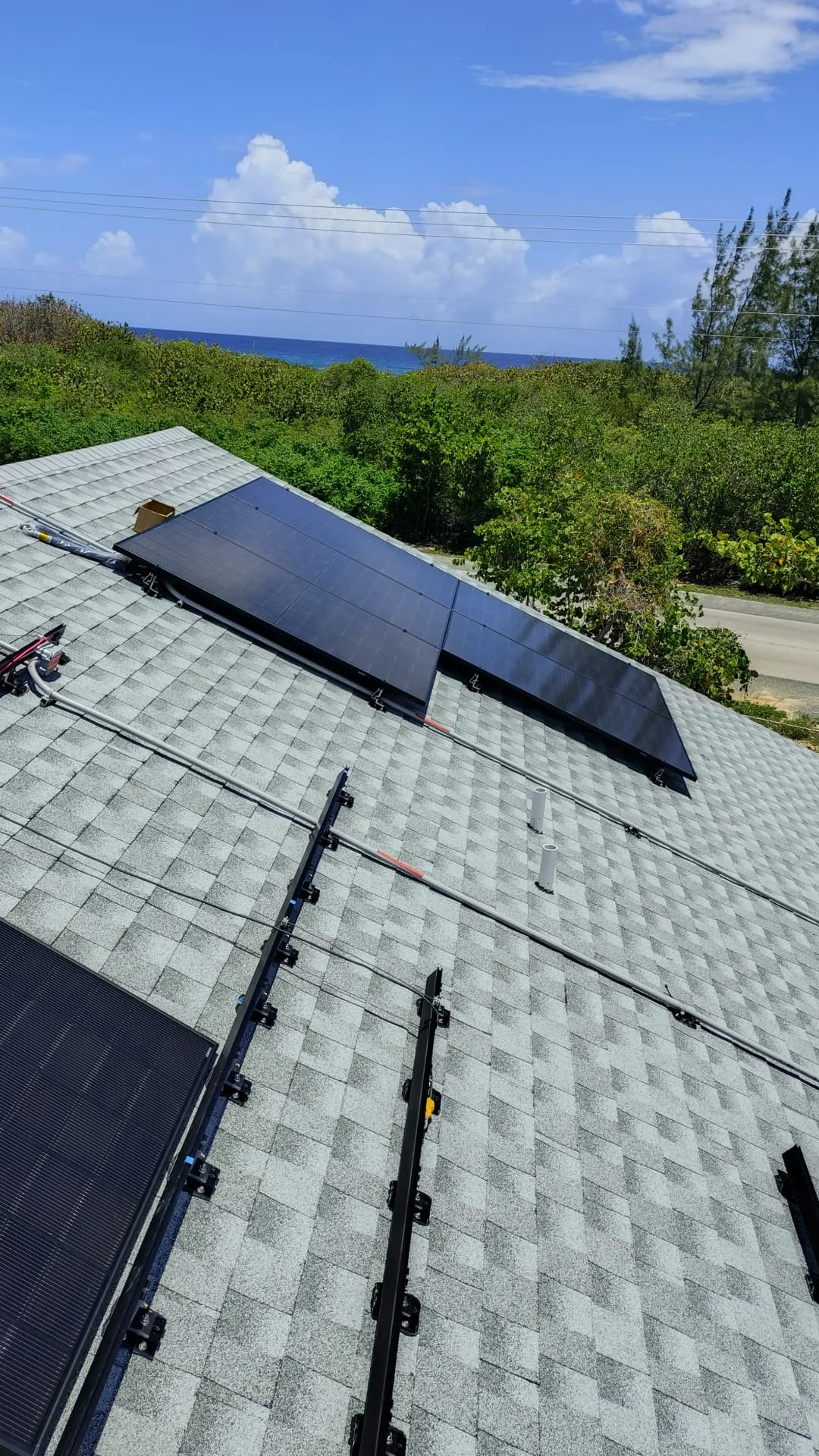
- Contributes to Cayman's goal of 70% renewable energy by 2037
Making the Decision: Is Solar Right for You?
Solar makes the most financial sense if:
- You own your property or have a long-term lease
- Your roof is in good condition with minimal shading
- You plan to remain in your property for at least 5 years
- Your monthly electricity bill exceeds CI$250
Even if you don't meet all these criteria, partial solar solutions or future installation may still be worth considering as technology improves and costs continue to decline.
Next Steps: Your Path to Solar Savings
Ready to explore whether solar makes financial sense for your specific situation?
- Energy audit — understand your current consumption patterns and identify efficiency opportunities
- Site assessment — evaluate your property's solar potential with a professional consultation
- Custom proposal — receive a detailed system design and financial analysis
- Financing selection — explore your options for funding your solar investment
- Installation — professional installation typically takes 2 – 5 days
- Activation and monitoring — connect to the grid and begin tracking your production and savings
Conclusion
The economics of solar power in the Cayman Islands have never been more favorable than in 2025. With the enhanced CORE programme rates, declining equipment costs, and rising utility prices, most homeowners can expect to recoup their investment within 4 – 7 years while enjoying decades of reduced energy costs.
Beyond the compelling financial returns, solar power offers energy independence, environmental benefits, and alignment with Cayman's national sustainability goals. As the islands move toward their target of 100% renewable energy by 2045, early adopters will enjoy the greatest financial benefits while leading the way toward a more sustainable future.